WELCOME TO POSTAL EMPLOYEES UNION

11 September 2013

FREQUENTLY ASKED QUESTION ON PFRDA/NPS-BILL


1. What does the new pension law do?

The PFRDA Bill, 2011, (proposed to be enacted as a law) provides for the establishment of an Authority to promote old age income security by establishing, developing and regulating pension funds, to protect the interests of subscribers to schemes of pension funds and for matters connected therewith or incidental thereto.
0
An Interim Authority has already been created vide Govt Resolution dated October 10, 2003, and November 14, 2008, and is fully functional. The passage of the bill will confer statutory status to the Interim PFRDA to develop and regulate National Pension System (NPS) earlier known as New Pension Scheme.

2. What is NPS ?

The National Pension System reflects (NPS) Government’s effort to find sustainable solutions to the problem of providing adequate retirement income.

The NPS is an easily accessible, low cost, tax-efficient, flexible and portable retirement savings account. Under the NPS, the individual contributes to his retirement account and also his employer can also co-contribute for the social security/welfare of the individual.

The NPS is designed on Defined contribution basis wherein the subscriber contributes to his account, there is no defined benefit that would be available at the time of exit from the system and the accumulated wealth depends on the contributions made and the income generated from investment of such wealth.

Eventual pension wealth is based on the level of contributions made over the years, the charges (administrative and fund management) deducted from the funds and the returns achieved by the investment fund (pension fund managers) used over a period of time during the accumulation phase in the NPS.

The greater the value of the contributions made, the greater the investments achieved, the longer the term over which the fund accumulates and the lower the charges deducted, the larger would be the eventual benefit of the accumulated pension wealth likely to be.


3. Why should one subscribe to a pension fund?

Pension ensures that a person has steady and adequate financial security during his old age, even after he has retired from employment or his earning capacity has extinguished/decreased.

4. What does the pension bill propose?

The PFRDA shall administer the NPS for subscriber’s interest in accordance with the provisions of the PFRDA Act and the rules and regulations framed thereunder. The Authority has the mandate to regulate all other pension funds (other than the NPS) which are not regulated by any other enactment.

5. Is it compulsory?

The NPS is compulsory in respect of persons appointed to public services in connection with the affairs of the Union, or to All-India Services, on or after 1-1-2004. It is also compulsory in case of employees of Central Autonomous bodies.

The NPS is also applicable in respect of employees of various state governments and its autonomous bodies, who have joined the NPS and in respect of whom, such state governments have extended the NPS based on the notifications issued by such states.

The NPS is voluntarily extended to the citizens of India w.e.f May, 2009, who may choose to be covered under the NPS. The NPS has also been extended to various corporates, who may choose to provide the scheme to their employees on a voluntary basis.

6. When was it first introduced?

The PFRDA Bill 2005 was introduced in Lok Sabha in March, 2005, but could not be considered and passed due to dissolution of 14th Lok Sabha. Earlier, the PFRDA Ordinance 2004 was promulgated on December 29, 2004, which lapsed on April 7, 2005.

7. Can one decide how much on ones savings should go into stocks and how much in debt?

Presently, in respect of government employees, the investment choice in asset class E (Equities), asset Class C (Corporate Debts) and Asset Class G (Government Securities) is in accordance with investment pattern contained in Ministry of Finance notification No. F. No. 5 (88)/2006 –PR.— dated August14, 2008. For others different schemes are applicable based on the choice exercised by the subscriber.

8. If stock prices crash, will pension be affected?

The rate of return and NAV (Net Asset Value) of the subscriber will be susceptible to market risk.

9. Can one choose the stocks in which pension fund will put the money?

Pension Fund Managers based on their expertise will choose the stocks for investing the collective monies of the subscriber (under full disclosure to the NPS Trust). However, individual subscriber will not have the option of choosing a particular stock.

10. Can one withdraw money whenever one wants or only after one retires?

The subscriber can exit from the NPS and withdraw the accumulated pension wealth in the following manner and no other exits or withdrawals are permitted presently:

a. Upon attainment of age of 60 years : At least 40% of the accumulated pension wealth of the subscriber needs to be utilized for purchase of an annuity providing for the monthly pension of the subscriber and the balance is paid as a lump sum payment to the subscriber.
b. Upon Death (irrespective of cause) : The entire accumulated pension wealth (100%) would be paid to the nominee / legal heir of the subscriber and there would not be any purchase of annuity/monthly pension.
c. Exit from the NPS before attainment of age of 60 years (irrespective of cause): At least 80% of the accumulated pension wealth of the subscriber needs to be utilized for purchase of an annuity providing for the monthly pension of the subscriber and the balance is paid as a lump sum payment to the subscriber.

11. Can it help the industry?

The industry can benefit by the availability of long term funds under the NPS, which may be deployed to build infrastructure. The industry can also provide the NPS as an important social security scheme to the employees serving in such industries.

06 September 2013

CONFEDERATION OF CENTRAL GOVT.EMPLOYEES CIRCULAR.

CONFEDERATION CIRCULAR


Circular No. 3/2013                                                                                                  Dated – 29.08.2013

To

All CHQ office Bearers, Confederation
All General Secretaries C-O-Cs
All General Secretaries/Secretary Generals of affiliated Unions

Dear Comrade,

1.    Agenda of the next National Council JCM has been finalized on 27.08.2013 in consultation with DOP&T. Twelve demands raised by the Confederation in the Charter of demands are included (including the GDS employees demand). The letter given by Com. Umraomal Purohit, Secretary, Staff Side, JCM National Council and twelve demands included in the agenda are enclosed herewith. (Annexure I & II) Next meeting of the National Council JCM is expected by the end of October 2013/early November 2013.

2.    The controversial PFRDA bill is listed as an agenda items of the current Parliament session. National Secretariat of the Confederation has given a call for two-hours walk out and protest demonstrations when the bill is taken up for discussion in Parliament or on the next day if information is received late.

3.      GET READY FOR INDEFINITE STRIKE, MAKE THE STRIKE BALLOT A GRAND SUCCESS
As already mentioned in the previous circular the following campaign programmes shall be implemented in all states demanding realisation of the 15 Point Charter.
          (a)   Mass Relay Dharna at all important places and State/District Head Quarters from 2nd to 7th September 2013.
          (b)   Holding of state conventions of C-O-Cs and Central Working Commitees/Central Executive Committees of all               affiliated Unions/Associations/Federations.
          (c)    Strike ballot from 25th to 27th September 2013.

A copy of the appeal for strike ballot and model ballot is enclosed herewith (Annexure III & IV). It may be translated into local languages. Each official should be given an appeal well in advance so that they can take an independent decision before the polling dates. 15 Point Charter may be permitted in the appeal.

On the polling day (25th, 26th & 27th September 2013) ballot boxes should be placed at the premises of offices or at a centralized place (polling booths) as per convenience. Employees may be allowed to vote freely and frankly by ticking “Yes” or “No” in the ballot. It will be a secret ballot. After ticking “Yes” or “No”, the ballot may be put in the ballot box. After polling is over leaders shall count the ballot.
The ballots in favour of indefinite strike (Yes) and against indefinite strike (No) may be counted separately and total figure arrived at may be communicated by the respective C-O-Cs or organizations as the case may be, to the Confederation Head quarters by e-mail or SMS.

Before the poling date intensive campaign should be conducted by all C-O-Cs and affiliates at all places and each and every employee may be contacted and requested to cast his/her vote.

4.      All India Trade Union Education Camp:
The Trade Union Education Camp will be held at Mumbai on 15th & 16th November 2013. The number of delegates to be participated from each C-O-C and affiliated Unions / Associations / Federations will be intimated before September 1st Week. The camp is being hosted by C-O-C Mumbai. Delegate fee is Rs. 600/- per head. NFPE, ITEF, Audit & Accounts Associations and Atomic Energy delegates shall be arranged accommodation by their respective Federations.

5.      All India Women’s Convention
The All India Women’s Convention of the Confederation will be held at New Delhi on 25th & 26th November 2013. Lady Delegates from all C-O-Cs and affiliated Unions/Associations/Federations should participate in the Convention. Number of women delegates to be participated from each C-O-C and affiliated Unions/Associations/Federations will be intimated by first week of September 2013. The Convention is being hosted by C-O-C Delhi. Delegate fee is Rs. 600/- per head.

6.      Formation of C-O-Cs at State and District level
As we are heading towards an indefinite strike, we have to gear up our organsiational machinery at all levels. Wherever state level C-O-Cs are defunct or ineffective it should be revived immediately. Where ever District Committee is not formed the major affiliates should take immediate action for preparing their rank and file for the indefinite strike. Circulars, bulletins, posters, boards, banners etc. may be issued and circulated widely among the employees. Don’t wait for the last Minute, Be prepared well in advance.

       Fraternally yours,
       (M. Krishnan)
      Secretary General


01 September 2013

Saturday 31 August 2013

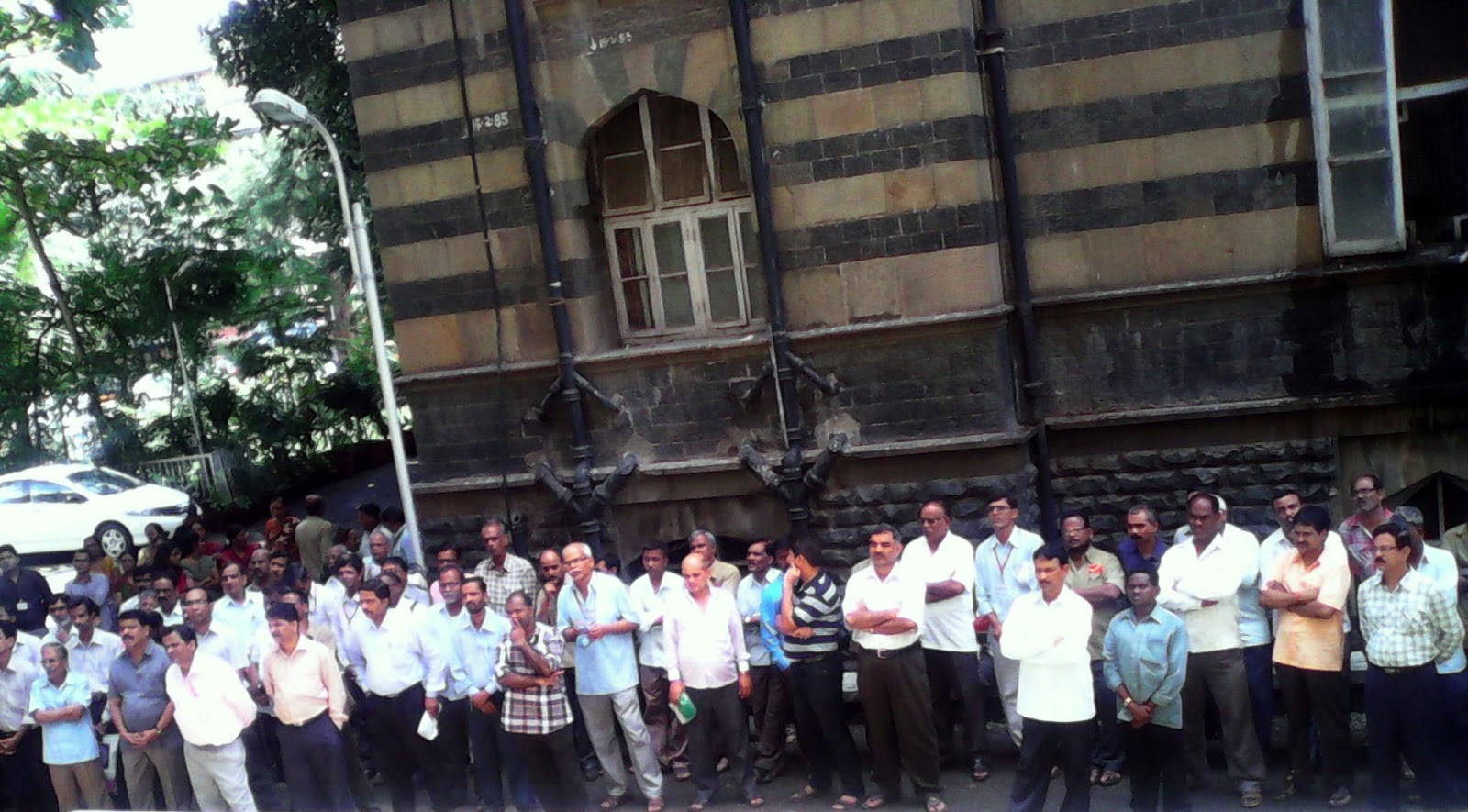
Photos of Lunch hour demonstration held at Mumbai GPO on 28.08.2013 on 15 Charter of Demands of Confederation


Besides this, from customers’ perspective, Post Offices offer products and services like small savings, postal life insurance and other mail related products which are used by the common man. All Women Post Office offers a secured environment to our woman customers from all strata of society to transact postal business with a level of comfort and familiarity with women employees of the Department.

This information was given by Dr. Smt. Killi Kruparani, Minister of State for Communications and Information Technology in a written reply to a question in the Rajya Sabha today.
 

THE POLICIES THAT FAILED
{Editorial Postal Crusader September, 2013}
                In the year 1991 when the New Economic Policy or the Neo-liberal Economic Policy was adopted by the then Narasimha Rao Government at the Centre with much fanfare, it was repeatedly declared that it is a panacea for all the crisis faced by the Indian economy and shall ensure rapid growth of Gross Domestic Product (GDP).  After 22 years, it is the very same neo-liberal policies which is leading the country to an economic disaster.  The then Finance Minister Sri. Manmohan Singh had brush aside the criticism and opposition of left parties and trade unions and they became a target of concentrated attack by the supporters of the neo-liberal policies.  Inspite of stiff resistance from all trade unions the Government went ahead with the rigourous implementation of the anti-people, anti-labour policies of Liberalisation, Privatisation and Globalisation  (LPG).
                While the UPA Government desperately wooed foreign capital and handed out concessions to big business and corporates, the plight of the people has been worsening because of the economic slowdown, falling industrial production and high inflation.  The rupee has steadily depreciated in value, with the exchange rate of the rupee to the dollar breaching the Rs.68 mark last week.  The current account deficit (the gap between exports and imports and other remittances) has reached an unsustainable level, there is rising external debt with the bourgeoning short-term debt, posing immediate problem.  This financial crisis is accompanied by high inflation.  The fact that the creation of two India’s of the rich and the poor, with the gap between them widening alarmingly, is a reality that stares us every moment.
                The first UPA Government was not allowed to implement the reforms in the financial sector, pension sector and retail sector etc. by the left parties who supported the Government.  It prevented the passing of PFRDA Bill by threatening to withdraw support to the Government.  The second UPA Government without the left support, started rigourous implementation of the reforms in all sectors.  All barriers for the inflow of foreign capital to the country was removed and the cap of Foreign Direct investment (FDI) in banking, insurance, pension, retail, defence, telecom etc. are either enhanced or removed.  Large scale disinvestment of public sector has become the order of the day.  Deregulation of petrol pricing has resulted in everincreasing prices of petrol and diesel fuelling inflation which resulted in the increased burden of price rise for the people.  Onions,vegetables and all other necessities of life are becoming out of reach of the people.  The other outcome of the economic slowdown is the loss of jobs in the industrial and services sectors and rising unemployment.
                The UPA Government is seeking to overcome this crisis by attracting more foreign capital and giving more concessions to the multinational companies (MNCs) and Indian big business.  The growing dependence on foreign capital flows and FDI has worsened the situation further and the entire exercise has proved futile.  The bulk of the capital flows out of the country is from equity, debt markets and Foreign Institutional Investments (FIIs), which the Government cannot control.  The neo-liberal policies of the Manmohan Singh Government and the boosting of the economy through Foreign Capital inflows have now come to roost. 
                During the last three years at least, the tax concessions provided to the corporartes and the rich amount to, according to budget papers, to over five lakhs crores every year.  Despite such “incentives”, the overall growth of the industrial production was minus 1.6 per cent in May 2013.  If, instead, these legitimate taxes were collected and used for public investments to build over much needed infrastructure, this would have generated large-scale employment.  This, inturn, would increase the purchasing power of the people and vastly enlarge domestic demand.  This would lay the basis for a turn around in manufacturing and industrial production and put the economy on a more sustainable and relatively pro-people growth tragectory. 
                What the country needs is an alternative pro-people policies.  Such an alternative can be brought about through the intensification of popular struggle of the people and working class in the coming months.
RISK ALLOWANCE TO CENTRAL GOVERNMENT EMPLOYEES - CLARIFICATION REG.(Click the link below for details) http://ccis.nic.in/WriteReadData/CircularPortal/D2/D02est/21012_01_2010-Estt.Allowance-26082013.pdf

31 August 2013

CONFEDERATION CIRCULAR

 Circular No. 3/2013                                                                                               Dated – 29.08.2013

To

All CHQ office Bearers, Confederation
All General Secretaries C-O-Cs
All General Secretaries/Secretary Generals of affiliated Unions

Dear Comrade,

1.   Agenda of the next National Council JCM has been finalized on 27.08.2013 in consultation with DOP&T. Twelve demands raised by the Confederation in the Charter of demands are included (including the GDS employees demand). The letter given by Com. Umraomal Purohit, Secretary, Staff Side, JCM National Council and twelve demands included in the agenda are enclosed herewith. (Annexure I & II) Next meeting of the National Council JCM is expected by the end of October 2013/early November 2013.

2. The controversial PFRDA bill is listed as an agenda items of the current Parliament session. National Secretariat of the Confederation has given a call for two-hours walk out and protest demonstrations when the bill is taken up for discussion in Parliament or on the next day if information is received late.

3.  GET READY FOR INDEFINITE STRIKE, MAKE THE STRIKE BALLOT A GRAND SUCCESS
As already mentioned in the previous circular the following campaign programmes shall be implemented in all states demanding realization of the 15 Point Charter.
            (a)   Mass Relay Dharna at all important places and State/District Head Quarters from 2nd to 7th September 2013.
          (b) Holding of state conventions of C-O-Cs and Central Working Committees/Central Executive Committees of all affiliated Unions/Associations/Federations.
            (c) Strike ballot from 25th to 27th September 2013.
                A copy of the appeal for strike ballot and model ballot is enclosed herewith (Annexure III & IV). It may be translated into local languages. Each official should be given an appeal well in advance so that they can take an independent decision before the polling dates. 15 Point Charter may be permitted in the appeal.
    On the polling day (25th, 26th & 27th September 2013) ballot boxes should be placed at the premises of offices or at a centralized place (polling booths) as per convenience. Employees may be allowed to vote freely and frankly by ticking “Yes” or “No” in the ballot. It will be a secret ballot. After ticking “Yes” or “No”, the ballot may be put in the ballot box. After polling is over leaders shall count the ballot.
   The ballots in favour of indefinite strike (Yes) and against indefinite strike (No) may be counted separately and total figure arrived at may be communicated by the respective C-O-Cs or organizations as the case may be, to the Confederation Head quarters by e-mail or SMS.
     Before the poling date intensive campaign should be conducted by all C-O-Cs and affiliates at all places and each and every employee may be contacted and requested to cast his/her vote.
    4.  All India Trade Union Education Camp:
       The Trade Union Education Camp will be held at Mumbai on 15th & 16th November 2013. The number of delegates to be participated from each C-O-C and affiliated Unions/Associations/Federations will be intimated before September 1st Week. The camp is being hosted by C-O-C Mumbai. Delegate fee is Rs. 600/- per head. NFPE, ITEF, Audit & Accounts Associations and Atomic Energy delegates shall be arranged accommodation by their respective Federations.

5.      All India Women’s Convention
The All India Women’s Convention of the Confederation will be held at New Delhi on 25th & 26th November 2013. Lady Delegates from all C-O-Cs and affiliated Unions/Associations/Federations should participate in the Convention. Number of women delegates to be participated from each C-O-C and affiliated Unions/Associations/Federations will be intimated by first week of September 2013. The Convention is being hosted by C-O-C Delhi. Delegate fee is Rs. 600/- per head.

6.      Formation of C-O-Cs at State and District level
As we are heading towards an indefinite strike, we have to gear up our organizational machinery at all levels. Wherever state level C-O-Cs are defunct or ineffective it should be revived immediately. Where ever District Committee is not formed the major affiliates should take immediate action for preparing their rank and file for the indefinite strike. Circulars, bulletins, posters, boards, banners etc. may be issued and circulated widely among the employees. Don’t wait for the last Minute, Be prepared well in advance.

Fraternally yours,


(M. Krishnan)
Secretary General


24 August 2013

Saturday 24 August 2013

DISCUSSIONS ON THE PENDING JCM SUBJECTS IN THE JCM (DC) STANDING COMMITTEE MEETING HELD IN 23.08.2013

The standing committee meeting of JCM (DC) was held on 23.08.2013 under the chairmanship of Member (O) to discuss the pending items of the last JCM (DC). Com. K. V. Sridharan, Leader Staff side, Com. Giriraj Singh, Secretary Staff Side, Com. M. Krishnan, Secretary General NFPE Com. D. Theagarajan, Secretary General FNPO represented the staff side. Com. Ishwar Singh Dabas, General Secretary, P4 NFPE, Com. T. N. Rahate General Secretary P4, FNPO were also present to discuss the postmen related issues.

The following are the decision in respect of important items.

1.         A new chairperson will be nominated with in a fortnight for further continuance of cadre restructuring proposal. A meeting with the staff side will be held within one month.
2.         The case of System Assistant will be looked into by the cadre review committee. The uniform duties and other ten demands pertaining to system administrators will be discussed in the same committee.
3.         Droping the practice of obtaining fidelity bond will be reviewed once again.
4.         The protection of pay of the defunct scale of PO & RMS Accountant case is being reviewed.
5.         The revision of cash allowance to the SPMs handling cash in the absence of treasurer will be finalized at the earliest possible.
6.         The committee reports for enhancing the line limits for cash remittance will be decided within a month. Providing van for cash conveyance for MNERGA payment will be considered.
7.         Fixing of norms to PSD and CSD will be considered only after the implementation of IT modernisation project.
8.         Allowing the physically challenged officials to appear in the IP examination, the referred case has not yet been finalized by the department of Social Justice. One more reminder and personal approach to expedite the approval will be made.
9.         The revised HSG I Recruitment rules ensuring 100% HSG I Posts to General line is under process. The revised recruitment rules for HSG I will be finalized within two months.
10.      The proposal for payment of incentive instead of honorarium for processing PLI/RPLI proposal will be finalized shortly. We pointed out about non-payment of RPLI incentive on monthly basis as per 2009, orders in most of the circles. It was assured to issue instructions to adhere the said instructions scrupulously. We pointed out the inadequate allotment of funds of clearing the pending incentive bills to the field officers and Agents and requested to allot the sufficient fund to wipe out all the pending bills forthwith. This was assured.
11.      The proposal for the grant of Excess duty allowance or restoration of charge allowance to the SPMs working in single and Double handed post offices will be considered.
12.      The issue regarding the counting of training period for the benefits of promotion under TBOP/BCR scheme as per the court judgment will be considered after getting the law ministry opinion as well as its implementation in respect of U.P circle at first.
13.      Holding of examination for the post of AMM in MMS and holding DPC for Dy. Manager MMS will be finalized within two months.
14.      The issue of appointment of Superintendent, Sorting in RMS will be finalized shortly.
15.      The staff side demanded to record disagreement in respect of the denial of cash handling allowance to treasures at par with cashiers. The chairman inform that we will have one more attempt with MoF. The staff side assured to submit a fresh detailed not above the justification in this case.
16.      The committee constituted to discuss about Group ‘B’ promotion under the chairmanship of Shir. V. K. Tiwari DDG (R&P) will finalise its recommendation within one month. The staff side presented our views which is enclosed herewith for the consumption of all comrades.
17.      In the issue of anomaly in the preparation of PA gradation list, we insisted whatever settled earlier should not be reopened. This was agreed and DDG (P) assured to give appropriate instruction to Tamilnadu Circle.
18.      Orders issued for protection of pay to employees who seek transfer to a lower post under FR 15(a)/under Rule 38.
19.      Construction for department building for DPA at Hyderabad. Proposal not agreed. In respect of Trivandrum and Patna, this is under process.
20.      Demand fresh establishment review for proposal/revival sanction of peripheral HRA will not be insisted hereafter. Proposal to upgrade the cities for drawal of HRA as per the 2011 census will be take up with MoF.
21.      The unjustified three conditions imposed for appearing IP examination for the departmental quota vacancies will be reviewed and modified shortly.
22.      The Civil wing Karnataka circle ensured the safety of the existing building at Kodial bail HSG I in Mangalore division and no possibility of new construction. As the accommodation is far below the SOA we insisted for shifting of the PO for a better building which will be examined.
23.      The construction work began for the new departmental building at Itanagar HO/North East Circle.
24.      The incentive for IMT work will be finalized shortly. The file is new pending with internal finance for approval.
25.      The recovery imposed on official for interest paid on PPF Accounts in case of Karnataka circle have been ordered to refund to the officials like Mysore and case settled.
26.      In case of fixation of pay for MTS by separate fixation for each MACP has been referred to the nodal ministry for clarification.
27.      Taking dies non period for reckoning of continuous service for grant of MACP will be further examined. We pleaded, in the MACP order, there is no qualifying service and it should be on continuous service for grant of MACP and thus all EXOL, dies non period should be taken as service.
28.      Orders have been issued with regard to recovery of Postage in case of foreign articles returned due to non availability of service – case settled.
29.      Clarification has been issued to fix 1800 grade pay after training for the canteen employees – case settled.
30.      The earlier order denying arrears on encashment of earned leave is modified and orders issued to pay the difference in encashment of EL for availing LTC.
31.      Orders issued to CPmGs to hold immediate DPCs for filling up of all vacant LSG, HSG II and HSG I.
32.      Orders will be issued shortly in relaxing the standard to GDS belonging to SC/ST quota in the appointment of Postal Assistant in the revised PA/SA Recruitment rules. One more instructions will be issue to all circle heads to have a special drive to fill up all the vacancies of PA, Postman etc. kept under residual vacancies.
33.      As the finalization revised recruitment rules for PA/SA is delayed due to non clearance by nodal ministries. It is decided to fill up the PA vacancies of circle office as per the existing recruitment rules.
34.      Orders issued by promoting the OS as AD recruitment.
35.      The earlier instructions will be reiterated in respect of observation of tenure in RMS, HRO and divisional offices.
36.      The IP Posts under Direct recruitment in J&K Circle cannot be filled up due to non allotment from UPSC.
37.      Clarifications were issued for short drawal of Grade pay in case of pharmacists in P&T dispensary.
38.      The recovery effected from the commutation of pension has been stopped as per OM dated 10.02.2009.
39.      A module will be finalised by the Directorate within two months for imparting training to the Group ‘D’ selected under Blind Quota for upgradation of their Grade pay to 1800/-
40.      A reference will be made to the nodal ministry for the grant of grade pay of Rs. 1800- to MTS who retired/expired from service after 13.08.2008 without having been imparted training.
41.      In respect of fixing of norms for postman work, a separate meeting will be held.
42.      The revision of double duty allowance is under active consideration.
43.      The demand for revision of LR strength as per volume IV has been disputed by the official side by citing the MOF order dated 24.08.1995. we are not accepting and conveyed to come up with full details in the next meeting.
44.      A provision will be made in the revised module software in Accounts for online facility of GPF Accounts directly by the officials.
45.      Updating Postal manual, Volumes are underway by a special team. It will be fianlised at the earliest possible.
46.      The proposal for bifurcation of Bastar Division is considered. The proposal for redeployment of Group ‘B’ posts for creation of separate division is under consideration.
47.      All circle heads will be addressed for the timely supply of uniforms to the officials. The staff side is also requested to furnish the details in case of non supply of uniforms to the officials in respect of any circle.
48. Staff side insisted for providing more feeder cadre post in case of PO & RMS. Account line officials and assured to submit a brief note on this for consideration. The meeting ended with the vote of thanks to the chair.
DISCLOSURE OF PERSONAL INFORMATION UNDER THE RTI ACT, 2005(Click the link below for details)